

“Don’t tamper with history”—we have all read it in books, heard it from our elders and may have even written it in our exams. But when the same thing comes on the screen of Indian cinema, suddenly everything changes. Historical truth, facts, chronology, culture—everything bows down to one thing: entertainment and profit.
The portrayal of history in Indian films is no longer entertainment, but a symbol of distortion. Directors and writers twist history to suit their scripts, so that they can make the hero great and the villain abuse-whatever the actual facts may be.
Historical Inaccuracies: The Cost of Drama in Bollywood

Rewriting the Past: Bollywood’s Take on History
The tradition of historical films is not new. We already have many films like Mughal-e-Azam, Jhansi Ki Rani, Sikandar showed respect and understanding for history. But today’s films—like Adipurush, Samrat Prithviraj, Panipat, and the recent Kalki 2898 AD—have turned history into either fashion or fantasy.
The people criticized the dialogues in Adipurush not because they were filmy, but because the filmmakers showed unprecedented carelessness with a cultural text like the Ramayana. Dialogues mocking Hanuman ji, showing Lord Shri Ram as an action hero—all this crossed the line where there is a balance between religiosity and creativity.
In Samrat Prithviraj, drama took precedence over historical accuracy, and Akshay Kumar’s presence overshadowed the real Prithviraj Chauhan. Similarly, Panipat’s portrayal of Afghans was historically questionable and fueled community tensions.
Drama Over Accuracy: The Price of Bollywood’s Creative Liberties

The Art of Distortion: How Bollywood Rewrites History
The modern portrayal of Mahabharata characters in the film Kalki 2898 AD neither creates faith nor curiosity, but instead creates confusion.
So, the question is why do filmmakers do this?
The first reason is TRP and visual appeal.
Big sets, heavy costumes, clanging of swords and wars decorated with VFX—all these bring the audience to the cinema. But the truth?
The second reason—less research and incomplete information.
Many scripts are based on superficial information available on the internet. Filmmakers often don’t consider consulting historians, digging into sources, or maintaining historical balance as necessary.
The third reason—political pressure and ideological propaganda.
Some films propagate openly, some indirectly. Some characters are made heroes, some villains—even if history says otherwise.
In such a situation, cinema is no longer just cinema, it becomes a tool to determine social direction.
Its impact is also visible.
Trailers spark a flood of screenshots, fact-checks, and memes on social media.
The Reel Deal: How Bollywood Distorts History for the Big Screen
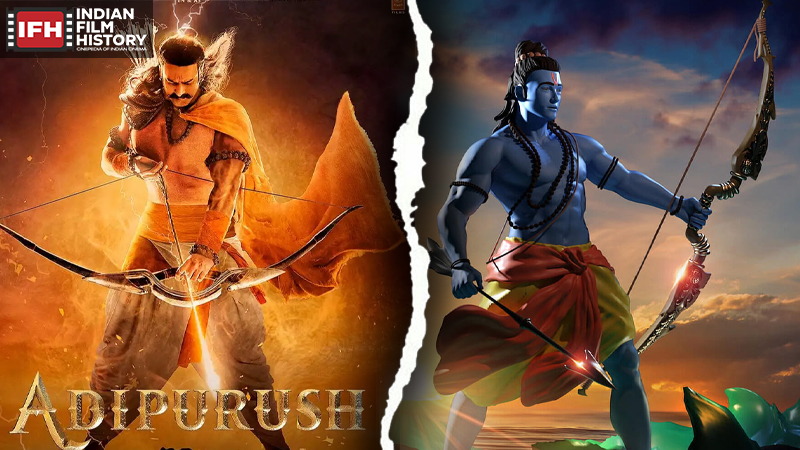
The controversy surrounding films like Adipurush and Kalki 2898 AD highlights the challenges of reimagining cultural and mythological narratives for modern audiences—is this a science-fiction version of our culture or just a Marvel-inspired design?
This is the first sign that now the audience does not just want entertainment, they also want to maintain the dignity of their history.
If films are the mirror of society, then the question arises—is Bollywood now the mirror that is showing real faces in a distorted manner? Have we limited our historical understanding to only VFX, popular stars and punchlines of dialogues?
The answer is simple—such films do not create history, but create confusion.
When a child reads Ramayana or Mahabharata in school and then watches its film presentation, he is unable to differentiate between truth and fiction. Portraying Prithviraj Chauhan as a Hollywood-style action hero or misrepresenting freedom fighters like Hemu Kalani leaves the younger generation confused about their history.
This confusion affects the intellectual level of the society.
Now many people believe that cinema does not teach history, but the reality is that today’s generation learns history from the screen, not from books. If lies are served on the screen, then that lie remains in the mind as truth for a long time.
When History Meets Hollywood: The Bollywood Twist
On the other hand, there is also a question—are only the filmmakers to blame?
We, the audience, are also complicit in this. When we allow films like Adipurush to earn crores in the first week itself, we are legitimizing that content. When we ignore controversial historical films by calling them mere “entertainment”, we blur our cultural memory.
It is also important to understand here that not all historical films are wrong.
Some directors have portrayed history with authenticity and sensitivity. The Legend of Bhagat Singh is a great example of this, where factual presentation, sensitive direction and serious acting made the film a document.
Similarly, Tanhaji also tried to strike a balance between entertainment and Maratha pride.
These films proved that if there is hard work, vision and honesty, then history can be shown not only beautifully but also truthfully.
Now the question is—is the path only of criticism or is there a solution as well?
First of all, there is a need for serious research and fact-based scripting.

If a historical film is being made, then the advice of subject experts, historians and cultural workers should be mandatory.
Second, it should be made clear at the beginning of the film whether it is a “fictional presentation” or a “film based on history”. This will make it easier for the audience to understand what they are watching.
Third, a joint committee of the censor board and historians should be formed, which will verify only films made on historical subjects. This will not only help in maintaining social harmony, but will also ensure the quality of the content.
Fact vs. Fiction: The Blurred Lines of History in Bollywood
Along with this, it is also the responsibility of the audience to differentiate between a film and historical truth, and promote such content which gives both knowledge and awareness.
The media, teachers, and writers can contribute by presenting factual criticism of historical inaccuracies in films and promoting film-history comparative studies in educational institutions.
Today, when there is no dearth of technology, creativity and resources, the question is not whether to make historical films or not—the question is whether we know how to do justice to history.
The power of cinema is not just in entertainment; it is also a medium of memory and education. Therefore, now the time has come that we should weigh every historical scene shown on the screen not just with applause, but also with questions.
This understanding transforms a viewer from a consumer to a responsible citizen.


Leave a Comment