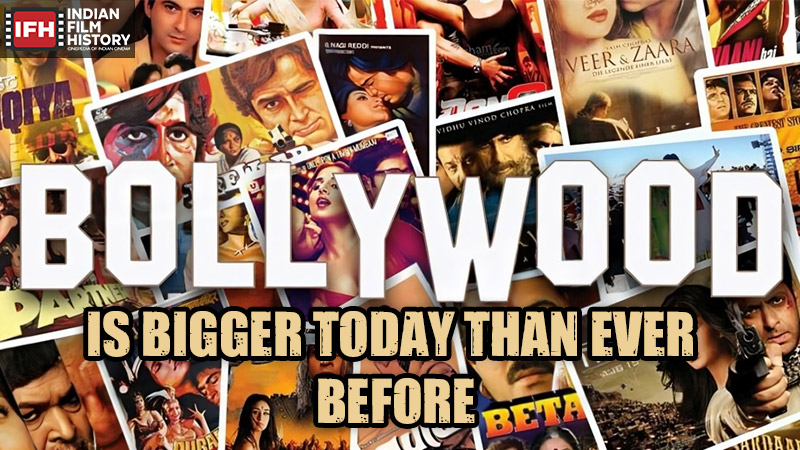

As we look at the world of Indian cinema, we first define the film industry. There is no film industry in the world more productive than that of Indian film Industry. Every year we have see an upward graph with thousands films that are released in India. Unlike Hollywood, Indian cinema covers vastly films from various languages across the regions in India. The largest of which is the Hindi language films, what we refer as Bollywood. We see India’s movie industry is thriving today.

But what is Bollywood?
If we focus specially on Bollywood, we first define the Bollywood industry by breaking down various factors before we look into the key films. The epicenter of Bollywood is in Mumbai and the name derived from its former name Bombay.
The style incorporated in Bollywood is defined by its expressive visuals, elaborate songs and dance sequences. Over the years Bollywood has become an industry that has appealed to the global masses with its diverse stories.
There are several other film industries within India, such as South India and Tollywood but none as big as the Bollywood.
In a technical term, its hard to ignore that Hindi cinema and Bollywood are the same thing. But Bollywood is associated with star power, masala films and musical numbers. We all know it is one of the most popular film industries that has the most ardent movie fans.

Some of the most notable movies of Bollywood.
Mother India in 1957, Pyaasa in 1957, Mughal-E-Azam in 1960, Sholay in 1975, Deewar in 1975, Lagaan: Once Upon a Time in India in 2001, 3 Idiots in 2009, Dangal in 2015, Pinik in 2016 to name a few.
Bollywood Movie Industry is thriving
Bollywood is a lot more than just the Hindi language films. It is one of the most popular setors of Indian movie industry which has thrived on with themes, narrative structures and visuals. In many ways Bollywood and Hollywood are quite alike but there are few key differences that sets them apart from being the same at a structural level.
To fully understand what Bollywood is today, we look back at where it started ? The British rule in India, which lasted from 1858 to 1947, significantly influenced Bollywood, introducing Western culture and shaping the industry’s early development. There have also been Indian films about ancient Sanskrit epics and not necessarily only exlicit westernized films before 1947 when India got its liberation. The two epics Mahabharata and Ramayana were the two epic films since 1920. But the landscape of Indian cinema solidified as one entity after 1947 when British partitioned the nation into India and Pakistan .
“The Evolution of Bollywood: A Journey to Global Stardom”
Mega star like Amitabh Bachchan who debuted in 1969 was the new generation of actors and slowly the Bollywood films became the major selling point for audiences. Bachchan set a precedent that films were more than just being a star. The 1970s films brought a revolutionary change to Bollywood, marked by grand productions, memorable storylines, and iconic performances that captivated audiences and left a lasting impact on the industry.
Salim – Javed, the screenwriting duo shifted their traditional structure in their stories In Bollywood cinema from musicals to more of crime focused films. The most sought after film Deewar , a tale of two brothers caught opposite each other by law. Yash Chopra directed the film starring Amitabh Bachchan and Shashi Kapoor , is one of the legendary films of Bollywood cinema and many other films that followed and hit the headlines one after another which set the Bollywood apart from the rest of the film industries.

Bollywood vs Hollywood
If we compare Hollywood vs Bollywood, we find that Hollywood is kind of realistic as they try to fit logic even with a fictional film where as Bollywood is a lot of a dreamer’s world where there’s dance, song, colourful costumes and dialogues which is its core.
We cannot really compare the two film industries but everyone believes that Hollywood philosophy is superior than Bollywood in film making. Though it may be true that Hollywood has a greater story line and the direction is one of its best where Bollywood is lagging. Bollywood’s films are a lot of imagination and social topics which great actors like Aamir Khan and many others have already done.
Bollywood films are often criticized at intellectual level. Why is it that only the Western standards are said to be perfect way to depict a story. Just like Hollywood, Bollywood also thrive on star power.

Indian Cinema as a Culture
India’s independence in 1947 sparked a creative explosion in Indian cinema, with diverse regional industries emerging. The Bengali film industry, led by visionary filmmaker Satyajit Ray, pioneered realism, producing thought-provoking and acclaimed films that showcased India’s rich cultural heritage.
On the main stream cinema, with Hindi language films , they became popular with stars such as Raj Kapoor, Dilip Kumar among many other stars of that era.
The star power continued to grow with the Kapoors and Kumars and the long association they have had with the films. They became so famous that the film would be a success or a hit or be bomb the box office because of the star presence. The financial aspect also greatly depended on the success and slowly solidified the status in the film industry.
Expanding Markets
Besides Bollywood we had Tollywood, films of South in Telugu and Tamil language films The Bengali films also continued to grow simultaneously. Films across India started releasing films in different languages with dubbed vocals and received a good star appeal.

The New Genre Emerges – Masala Films
Many westerners or people from out of India have a preconceived notion of Bollywood Movies. Films are popular for its pompous, musical and romantic stories. These widely popular films are often referred to as “masala films” due to their blend of emotions, action, romance, and drama, with scripts that require a generous dose of imagination and entertainment value. A mixed genre for sensational effect.
The first masala film was written by Salim Javed in 1973 for the film Yaadon Ki Baraat. Directed by Nasir Hussain, audience flocked to the theatres for its melodious songs, the script which had the fervor for the mix genre and it hasn’t stopped in the last fifty years since then. The trend of mix genre films has continued in Bollywood.

Bollywood film industry today
Let’s look at where the Bollywood Industry is today. According to business data, Bollywood has seen a consistet growth in terms of feature films produced and distributed per year. Bollywood has been a powerhouse showing no signs of slowing down. It is dominated by the stars of Hindi cinema. Some of the top stars like Shah Rukh Khan, Aamr Khan, Salman Khan, Akshay Kumar to name a few are still the biggest stars of the film industry. It is also worth noting that Amitabh Bachchan is still one of the biggest star in the country as Robert De Niro is the top star in Hollywood.
Anurag Kashyap’s films one of the renowned directors of Hindi cinema has helped Bollywood moves to transit away from the masala movies. It is evident in Kashyap’s films about his work which is a sort of symbol of modernisation amidst the masala-dominated films and epic stories of the Indian culture..
“From Humble Beginnings to Global Phenomenon”
It’s clear that Kashyap is a scholar of film history, which is evident in his work. Moreover, Kashyap is a sort of symbol for a modern renaissance of Hindi cinema.Bollywood still favors masala films and epic stories, but the 21st century has also brought more intimate narratives. Bengali cinema, meanwhile, is known for art films. In the 20th century, the move towards stories of realism was termed the “Parallel Cinema Movement,” because it paralleled the realism movements of cinema in Italy and France.
However, Tollywood Parallel Cinema, although largely critically acclaimed, struggled to find financial success. Only time will tell if Bollywood’s shift towards realism will yield greater success.

Bollywood is clearly in the midst of an industry change. More films are addressing social themes, such as feminism and wealth inequality. Zoya Akhtar, daughter of the great screenwriter Javed Akhtar, is one of several prominent female directors working today in Bollywood.
The 2016 Bollywood film Pink became internationally famous for its depiction of women’s rights.
Pink (2016) • Trailer
Pink is just one film that is changing the landscape of Hindi-cinema though others include: Pad Man, Well Done Abba and Antardwand, all of which won the National Film Award for Best Film on Other Social Issues.
UP NEXT
Lumière Brothers’ Timeline
The Lumière Brothers, Auguste and Louis, stand as two of the most influential figures in the history of cinema. Their innovative work in the late 19th century laid the groundwork for the development of modern film.
From their humble beginnings in Besançon, France, to their first commercial film screening in Paris, the brothers’ extraordinary journey is a testament to their indelible mark on cinema and visual arts.
Origins in Photography
The Lumière family’s journey into the world of images began with Antoine Lumière, the father of Auguste and Louis. Antoine was a successful painter who later transitioned into photography, drawn by its novelty and potential.
His business acumen led him to establish a small factory producing photographic plates in Lyon, France, in 1881. This venture thrived and became a leading manufacturer of photographic equipment and supplies, laying the foundation for the Lumière Brothers’ groundbreaking contributions to cinema.
The brothers grew up immersed in this environment, cultivating a deep fascination with images and the technology behind them. This video by CrashCourse dives into the background and origins of the Lumière brothers and their impact.
The Lumiere Brothers: Crash Course Film History
Edison’s Influence
In 1894, they encountered Edison’s Kinetoscope, an early motion picture device that only allowed one viewer at a time. Inspired yet recognising its limitations, the Lumière brothers set out to improve upon this technology.
Cinématographe
In 1895, the Lumière Brothers introduced the world to the Cinématographe. This device, a combination of a motion-picture camera, projector, and printer, was a significant leap from Thomas Edison’s Kinetoscope.
The Lumière Brothers’ invention was portable, produced higher-quality images, and had the capacity to project to numerous viewers simultaneously.



Leave a Comment